
Retail contactless familiarity does not prove that an online gambling service offers Google Pay for deposits or withdrawals.
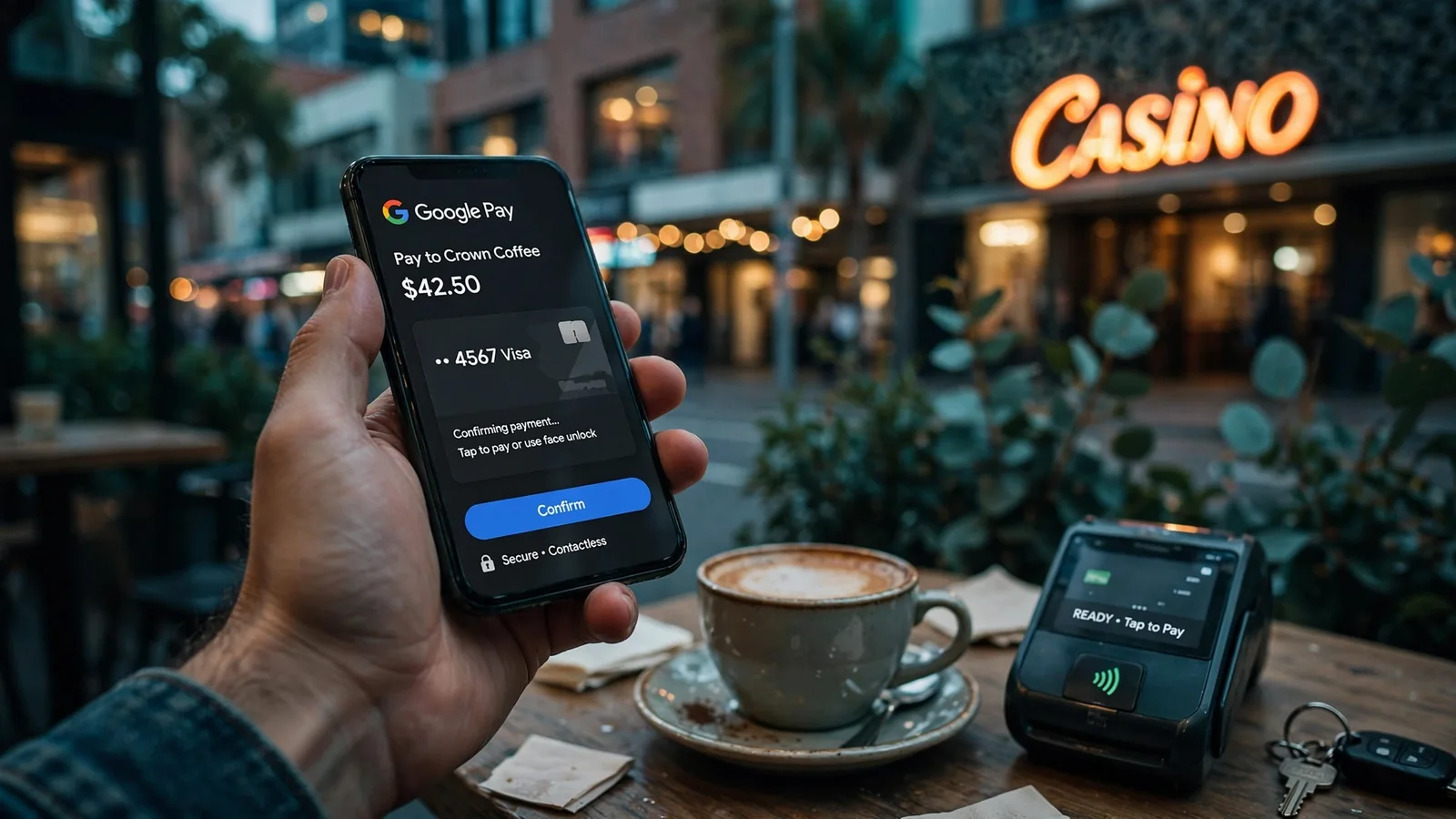
In Australia, tapping a phone to pay is an ordinary part of shopping. Contactless card payments are accepted almost everywhere, and mobile wallets such as Google Pay and Apple Pay are similarly common. That familiarity can make an online payment claim sound straightforward: if your phone works at a local checkout, surely it should work on a website too. The comparison is tempting, but it skips the key distinction. Everyday acceptance says something about Australian retail; it does not establish that a particular online service accepts a mobile wallet.
For consumers, moving between cards, mobile wallets and bank-linked services such as PayPal is familiar. Those options can sit side by side in everyday financial life, but they are not interchangeable from a merchant’s point of view. A retailer, bank, payment provider and online service each have their own role in whether a transaction is offered and completed. Having Google Pay set up on your phone therefore does not, by itself, tell you what payment options an online gambling service makes available.
If you want to pay with Google Pay, confirm that the casino currently supports it before depositing; the details below do not establish Google Pay availability. Use each card to check the operator information that is available to you.
SkyCrown
You can note its Tobique Gaming Commission licence and A$30 minimum deposit. Listed payout estimates are around 10–15 minutes for crypto and 1–5 days for fiat.
Kingmaker
You can use the listed A$30 minimum deposit as a reference. Payout estimates are around 90 minutes for crypto and 1–5 days for fiat.
LevelUp Casino
You can check its Curacao eGaming licence, OGL/2023/174/0082, held by Dama N.V., and its A$15 minimum deposit.
Neospin
You can note its Curacao Gaming Control Board licence, OGL/2023/176/0095, held by Hollycorn N.V.
House of Pokies
You can note that its source describes an international iGaming licence without naming the jurisdiction. PayID withdrawals are listed at 1–24 hours, with a A$30 minimum deposit or A$10 for PayID.
Uptown Pokies
You can note its Curacao operation, which is listed as running since 2017, and its A$20 minimum deposit.
LuckyVibe
You can note its Curacao Gaming Control Board licence, OGL/2023/176/0095, held by Hollycorn N.V.
Wild Tokyo
You can note its Curacao licence and A$10 minimum deposit. Listed payout estimates are 30–60 minutes for crypto and 1–5 days for fiat.
7Bit Casino
You can note its Curacao licence and that it is operated by Dama N.V.
DragonSlots Casino
You can note its Curacao Gaming Authority licence, with Jumpman Gaming Ltd named as the operator.
That matters when you are trying to assess claims about Australian online pokies and Google Pay. The phrase “mobile casino” can describe a site viewed on a phone, while Google Pay describes a way of making a payment. One does not prove the other. A website may be designed for a mobile screen without offering a phone wallet, and the fact that Google Pay is widely used in Australian shops cannot be treated as evidence of acceptance by an online gambling operator.
There is also a legal distinction that changes how these claims should be read. Under the Interactive Gambling Act 2001, providing real-money online casino games to people physically in Australia is prohibited. That category includes casino-style games such as poker, blackjack, roulette and slots. The Australian Communications and Media Authority is responsible for enforcing the Act. This is not a setting in which an online casino can be presented as an ordinary local retailer with a familiar payment button.
The law addresses operators providing those services; it does not make a player criminally liable simply for using an offshore site. That does not make using one equivalent to shopping with an Australian business. Australian consumer law does not protect players who use offshore casinos. If a payment or account dispute arises, the familiar protections associated with a domestic consumer transaction should not be assumed to apply. Familiar payment branding does not change that position.
The useful comparison is therefore not “Does Google Pay work in Australia?” It plainly has broad everyday acceptance. The more relevant question is whether a specific service can lawfully offer the activity to people in Australia and whether its own payment arrangements actually include Google Pay. Those are separate matters. Neither a phone wallet’s popularity nor the presence of a mobile-friendly page establishes either point.
 Freshbet payment methods across fiat, crypto and cashout limitsFreshbet Notes Australia Freshbet supports cards, bank transfer, e-wallet and voucher-style methods alongside BTC, BCH, ETH, LTC, XRP, DASH, XMR, USDT, USDC…
 EcoPayz casino sites in Australia: what is confirmedThis article separates unverified EcoPayz payment claims from confirmed facts and explains that Australian law bars real-money online casino games.
A payment method can also appear in general descriptions without being available in the precise circumstances a reader has in mind. A logo, a short list of wallet brands, or a sentence saying that mobile payments are supported may leave important details unclear: which service is being described, who operates it, where it is available, and what the payment statement covers. The sensible reading is narrow. A general reference to Google Pay is not proof that every page, account or transaction associated with a site can use it.
This is why searches for an Australian online casino that accepts Google Pay can lead to a misleadingly simple answer. “Australian” may refer to the intended audience, the currency displayed or the wording of a page; it does not establish that the operator is an Australian business or that the service is lawful to provide here. Likewise, “accepts Google Pay” may be a broad promotional claim rather than a clear statement about a particular transaction. Labels do not settle questions that depend on the operator and the actual service.
If a page combines Australian language, a mobile layout and a payment logo, treat those as three separate signals rather than one combined assurance. A mobile layout tells you about display. A wallet logo suggests a payment association, but its meaning depends on the context in which it appears. Australian wording tells you how the page is being presented, not whether an offshore service falls under Australian consumer protections. This separation is more useful than treating familiar design as evidence of reliability.
Legal Warning
Under the Interactive Gambling Act 2001, providing real-money online casino games to people in Australia is prohibited, and Australian consumer law does not protect players using offshore casinos.
The same caution applies to “best” lists and claims about new Google Pay pokies. A ranking can compare only the criteria it actually establishes; a wallet mention does not verify that a payment route is available to an Australian user, and it does not resolve the legal status of the service. Nor does a current-looking page make an operator’s offer lawful. The decisive criteria are not whether a site looks local or opens conveniently on a phone, but what service is being offered, to whom, and what protection applies if something goes wrong.
There is a practical limit to what can be inferred from Australia’s everyday payment habits. Broad acceptance of Google Pay at shops shows that the wallet is familiar and widely usable in ordinary retail settings. It does not provide a directory of online gambling operators, confirm the payment options of any one site, or transform an offshore casino into a protected local service. A wallet is a payment tool, not a legal status or consumer safeguard. Useful distinction.
So if you are comparing claims about Google Pay and Australian online pokies, keep the categories apart. Retail acceptance describes the checkout experience across everyday businesses. A casino payment claim concerns a particular operator and its own arrangements. The legal framework concerns whether the service may be provided to people in Australia, while consumer protection concerns what recourse you have if a dispute occurs. Conflating those questions can make a familiar payment name seem more reassuring than it is.
 Casinos That Accept Litecoin in AustraliaCompare Litecoin with cards, mobile wallets and bank-linked services, and review bonus terms, withdrawals and Australian access before treating it as an…
 Casinos That Accept Neteller in Australia: What to CheckLearn why Australian card and wallet habits do not confirm casino support, what to check before depositing, and why Neteller withdrawal speed…
The clearest answer is deliberately limited: Google Pay is part of everyday Australian commerce, but that fact alone cannot verify acceptance by an online gambling site. It also cannot establish that a site offering real-money casino games to people in Australia is operating within the rules or that Australian consumer law will protect you. When a page uses familiar wallet branding, read it as a claim about a payment method—not as proof of local legality, local protection or a dependable service.
A deposit and a payment for a game are different transactions. A deposit, in the usual account-based model, means transferring funds to an account balance. A game-level payment would mean paying for a particular game directly, rather than first adding funds to an account. Treating the two as interchangeable can make a payment label look more informative than it is.
For Google Pay, the distinction matters because a general claim about a payment method does not establish how a particular service uses it. Even if a payment option is shown somewhere, that alone would not tell you whether it funds an account, applies to a particular game, or is available to a person in Australia. Those are separate questions, and each would need clear, current evidence.
Transaction Types
A deposit funds an account balance, whereas a game-level payment is a direct transaction for a specific game; these two methods are not interchangeable.
To establish that a payment method can fund an account, a claim needs to identify the actual payment route and the transaction it supports. A statement that a site “accepts” Google Pay is incomplete if it does not clarify whether that means deposits, another kind of transaction, or simply that the payment method is recognised in a different context.
The distinction is not a technicality. A payment option can be relevant to one stage of a service without being available at another. The word “deposit” should therefore be tied to an account-funding transaction, not inferred from a logo, a general payment-method list, or wording beside a game.
A figure in a payment headline does not settle the question either. A stated deposit amount, by itself, would not prove that Google Pay is available, that the transaction can be completed, or that the payment is accepted for a particular game. The amount and the method are different details. Both would need to be supported, and a reader should not have to guess which one a claim actually verifies.
Many online services separate an account balance from the individual activities available through that account. In that arrangement, a payment method would fund the balance, while the service would record later activity separately. That description explains the difference in terms; it does not establish that any particular gambling service in Australia uses Google Pay in this way.
 Casinos That Accept PayID in Australia: What to CheckLearn how to verify PayID in a casino cashier, compare acceptance and costs, and distinguish payment support from game availability.
 Osko and Casino Sites in Australia: What Is VerifiedLearn how to assess Osko acceptance claims, distinguish bank transfers from Osko, and understand the Interactive Gambling Act 2001 context.
The reverse inference is just as weak. A game being accessible through an account does not demonstrate that it can be paid for directly with Google Pay. Nor does a payment symbol placed near a game establish that the game itself accepts a wallet transaction. Without explicit information about the transaction, the symbol cannot answer whether the payment is for the account or for the game.
This is why claims about deposits and claims about game payments should not be collapsed into one label. If you are assessing a statement, identify the subject of the transaction first: is it an account balance, or a particular game? Then ask whether the payment method is explicitly connected to that transaction. If either part is unclear, the claim has not established the route.
Before financial transactions, online gambling services typically ask customers to complete identity checks known as Know Your Customer, or KYC, assessments. That process is separate from whether Google Pay is offered. Completing an identity assessment would not prove that a specific wallet is accepted, and the presence of a wallet option would not remove the need for account checks.
Payment claims should also be read in the context of Australian law. The Interactive Gambling Act 2001 prohibits operators from providing real-money online casino games, including pokies, to people physically located in Australia. The Australian Communications and Media Authority enforces the Act. This is not a market where an Australian reader can treat an offshore casino payment page as an ordinary local service.
Australian consumer law does not protect players who use offshore casinos. That is an important limitation when considering any claim about deposits: a polished payment description does not create local consumer protections or change the legal position. Do not interpret information about a payment method as an endorsement or an invitation to use an offshore gambling service.
Keep the assessment narrow. A clear claim would need to say what transaction is supported and identify Google Pay as the method for that transaction. If the wording only says that a casino “accepts” the wallet, it leaves the deposit question unresolved. If it mentions a game but does not say how funds are applied, it leaves the game-payment question unresolved.
A comparison is useful only when the same criterion is applied to each claim. For deposits, the criterion is explicit evidence that the method funds an account. For a direct game payment, the criterion is explicit evidence that the method pays for that game. A claim that meets one test does not automatically meet the other. The better-supported statement is the one that names the transaction, not the one with the broadest wording.
The same standard applies to a low-value deposit claim. A small amount can sound precise, but precision about an amount does not establish availability of the payment method. Nor does it tell you whether the figure is a minimum, a sample transaction, or simply promotional wording. Without evidence that connects the method, transaction, and stated amount, the details should not be treated as confirmed.
This standard also prevents a common category error: confusing a familiar mobile wallet with verified acceptance by a gambling operator. Everyday familiarity says nothing about whether an online casino offers the wallet for account funding. And evidence of account funding, if it existed, would still not prove that a player could pay for each game directly through that wallet.
 Casinos That Accept POLi in Australia: What’s VerifiedSee why a casino listing alone does not confirm POLi is available to Australian customers, and which deposit, withdrawal and bonus claims…
 Mastercard at Australian Online Casinos: What’s VerifiedLearn why a Mastercard logo alone does not confirm Australian availability, and what to check about payment access, withdrawals and casino claims.
The defensible distinction is simple: account deposits and game-level payments are not the same thing. Each claim needs to identify which transaction it describes and show how Google Pay relates to it. A payment label, a game reference, or a stated amount cannot fill in those missing links on its own.
For anyone in Australia, that assessment sits beneath a more important boundary: operators are prohibited from offering real-money online casino games to people in the country, and Australian consumer law does not protect people who use offshore casinos. Payment wording cannot change either point. Clear terminology helps you understand what a claim is asserting; it does not make the service lawful or provide a reason to use it.
A claim that an online casino accepts Google Pay needs to be read as a specific statement about a particular operator, not as proof that the payment option is generally available to Australian players. The wording can sound definite while leaving important details unclear: whether the claim refers to Australia, whether it concerns deposits or another transaction, and whether it describes a current service rather than an old listing.
That distinction matters because familiar payment labels can create a false sense of certainty. Google Pay is widely used for everyday purchases in Australia, but that does not establish that an online gambling operator accepts it. Nor does a page mentioning the wallet establish that the operator may lawfully provide casino games to people in Australia. These are separate questions, and an answer to one cannot stand in for an answer to the other.
Check if the claim identifies the specific operator, confirms availability for customers in Australia, and clarifies whether it refers to deposits, withdrawals, or other transactions.
The claim is meaningful only when it identifies the relevant operator and transaction. A page that names Google Pay somewhere in a general list of payment options may not show whether it is available to Australian customers, or whether the reference concerns funding an account rather than another kind of payment. The label alone does not settle those details.
You should also distinguish an operator’s own cashier information from a third-party description. A review, directory or comparison page may summarise payment options, but its wording is not the same as a current statement from the operator. Even an operator’s own page can be incomplete: payment methods may depend on the customer’s location, account status or the options displayed at the time of a transaction.
A useful standard is therefore narrow: a payment claim should say who offers the method, for which transaction, to customers in which location, and where the customer can see the method before proceeding. If those details are absent, treat the statement as incomplete rather than filling the gaps with assumptions.
This is not a recommendation to test a payment route. It is a way to avoid treating a broad label as a confirmed service. The distinction is basic, but easy to miss.
Lists labelled “best” can make a payment claim seem settled by placing operators in ranked order. Yet a ranking may be based on criteria unrelated to Google Pay, and it may not show how the payment information was checked. A site could rank highly for its own reasons without establishing that the wallet is available to Australian customers.
 Casinos That Accept Visa in Australia: What to CheckA specialist review suggests Visa may be accepted more widely than Amex, but that is not a guarantee. Learn what to check…
 Casinos That Accept Neosurf in Australia: What to CheckLearn why search terms do not confirm Australian availability, and what to verify about Neosurf deposits, withdrawals and casino bonus claims.
The word “best” also hides the criterion. Best for which feature: a payment option, a particular transaction, or something else? Unless the comparison explains its measure and supports the underlying claim, the position in a list adds no evidence about acceptance. A polished table is still only as useful as its entries.
For a reader comparing claims, the relevant question is not which site appears first. It is whether the payment statement is specific, current and tied to the correct location and transaction. If it cannot answer those points, its ranking does not repair the omission.
There is no single winner without a defined criterion. More importantly, a favourable payment label does not resolve whether an online casino service can lawfully be offered in Australia.
Australia’s legal position is central to any discussion of real-money online casinos. Under the Interactive Gambling Act 2001, operators must not provide real-money online casino games to people located in Australia. The prohibition covers casino-style services such as poker, table games and slot-style games; it is directed at the service provider.
The Australian Communications and Media Authority is responsible for enforcing that law. Offshore access is also subject to active blocking and enforcement measures. The fact that a website or payment description can be found online does not make the underlying service lawful for an operator to provide to people in Australia.
Attention: The presence of a familiar payment logo or a high ranking does not grant an operator permission to provide prohibited gambling services in Australia.
Players are not subject to criminal or financial liability merely for using an offshore casino, but that does not make the service legal or remove practical risks. Australian consumer law does not protect players who use offshore casinos. If a dispute arises, you cannot assume that ordinary local consumer protections will apply to the transaction or the operator.
That is why a payment claim should never be treated as a sign of approval, oversight or consumer protection. Google Pay acceptance, if asserted, would describe a payment capability; it would not grant an operator permission to offer prohibited gambling services in Australia. Payment convenience and legal status are different columns.
When you encounter a statement about Google Pay, look for its scope rather than its sales language. Does it clearly refer to Australian customers? Does it say whether the method applies to deposits, withdrawals or another transaction? Is the information presented by the operator itself, and does the relevant cashier actually display the option for the customer’s location?
Those checks help assess what the claim says. They do not turn an offshore casino into a lawful Australian service, and they do not provide consumer protection where that protection does not apply. If a page leaves the transaction or location ambiguous, the careful reading is that the claim has not answered those questions.
 BPAY at Australian Casino Sites: What the Evidence ConfirmsLearn why bank-linked payments do not confirm BPAY, and why deposits, withdrawals and operator-specific acceptance require separate evidence.
 Bitcoin Casinos in Australia: Rules, Payments and PlayLearn how Australia's Interactive Gambling Act 2001 applies to offshore casino operators, and what to check about BTC deposits, bonuses and withdrawals.
Be wary of wording that moves from “Google Pay is mentioned” to “Google Pay is available,” then from availability to a suggestion that the service is suitable for Australian players. Each step requires separate support. A wallet logo, a generic payment list or a ranking badge cannot establish all three.
The same care applies to claims about speed, fees or withdrawal options. Those are distinct service terms, not automatic consequences of a payment label. Do not infer them from a statement that names Google Pay, and do not treat an attractive description as a guarantee.
A compact way to assess a claim is to separate its parts:
| Point to assess | What the claim needs to make clear |
|---|---|
| Operator | Which service is being described |
| Location | Whether the statement specifically concerns customers in Australia |
| Transaction | Whether it refers to deposits, withdrawals or another payment |
| Evidence | Whether the information comes from current operator material or a third-party summary |
| Legal position | Whether the service may lawfully be provided to people in Australia |
This is a reading framework, not a shortlist. It does not identify or endorse a casino, and it cannot make an offshore gambling service lawful. Its purpose is to prevent one narrow claim—about a payment label—from being mistaken for proof of a broader claim about availability, reliability or legal standing.
When a page calls a casino a Google Pay option, the decisive question is what precisely that statement establishes. If it does not identify the operator, the Australian context and the transaction, the label is too broad to support a firm conclusion. If it does provide those details, the legal restrictions still apply. Payment wording cannot overrule them.
A payment route that lets you add money to an account does not, by itself, establish how money could be sent back. Depositing and withdrawing are separate functions. A wallet might appear as a way to pay in without being available as a way to receive funds, and a withdrawal method might be subject to conditions that do not apply to deposits.
Payout Distinction
A payment route used for deposits does not automatically establish how funds are returned; depositing and withdrawing are separate functions with different conditions.
That distinction matters when a claim promises an instant Google Pay withdrawal. The word *instant* is only useful if it describes a clearly defined step: for example, the time before a request is reviewed, or the time after it has been approved. Those are not necessarily the same event. Without a stated process and a defined measure of time, “instant withdrawal” is a label, not a reliable estimate of when funds would reach you.
Google Pay is a wallet used to make payments. That description alone does not establish that an online service can return funds to it. A withdrawal depends on the service’s payout arrangements and the payment route available for the customer’s account. You should not infer that a withdrawal will go back to the same place simply because a deposit was made using a wallet.
Keep the two questions separate:
| Question | What it concerns |
|---|---|
| Can a payment be made using Google Pay? | Whether the wallet is offered for an outgoing payment |
| Can funds be returned through Google Pay? | Whether it is supported as a destination for a withdrawal |
| How quickly could a withdrawal arrive? | The stages and timing of the payout process |
An answer to the first question does not answer the other two. A payment logo or a cashier option cannot settle all three.
An instant withdrawal claim can blur several stages into one phrase. A request may be submitted, reviewed, approved, and then sent through a payment route. A statement about one stage does not necessarily describe the whole path from request to receipt. For that reason, a speed claim should specify what event starts the clock and what event stops it.
The distinction is practical, not pedantic. “Processed” might refer to a request being handled by the service; it does not necessarily mean the money has arrived in a wallet or is available to use. If a claim does not define its terms, you cannot compare its promised speed with another claim on a like-for-like basis.
Do not treat *instant Google Pay pokies withdrawals* as a single feature. It combines a game category, a payment brand and a timing promise, each of which raises a different question. The presence of those words together does not show that Google Pay is an available payout destination, or that a withdrawal would be immediate.
A cashier or payment page may use a familiar wallet name to describe a payment option. That is not the same as a clear statement about withdrawals. Read the withdrawal terms separately and look for the specific method named as the destination, any conditions attached to it, and what the service means by “processing” or “instant.” If those details are unclear, the speed claim cannot tell you when funds would be received.
Attention: "No deposit" labels and new payment badges do not provide evidence regarding the availability or speed of withdrawal routes.
This is also why “no deposit” wording does not answer a withdrawal question. It describes an offer or account condition, not the route by which money would be paid out. A “no deposit” label cannot establish that a Google Pay withdrawal is available or say how long one would take. Those are separate matters.
Likewise, a newly presented payment badge is not evidence of a newly available payout route. A site can change its wording or payment display without that alone explaining the withdrawal process. The relevant detail is what the terms say about sending funds to the customer, not simply whether Google Pay appears somewhere on a page.
There is a more basic issue for Australian readers. The Interactive Gambling Act 2001 prohibits operators from providing online casino games to people in Australia. The Australian Communications and Media Authority (ACMA) is responsible for enforcing the Act. The law does not explicitly criminalise players for using offshore sites, but that does not make those services lawful for operators to offer to Australian residents.
Australian consumer law does not protect players who use offshore casinos. That matters when assessing a promise about payout speed or method: a payment claim is not a substitute for the protections available in a lawful consumer relationship. Online casino services offered to people in Australia are also subject to active blocking and enforcement. No payment label changes that legal position.
A search for an instant Google Pay withdrawal casino in Australia therefore should not be read as proof that a lawful local casino service exists. Nor does a claim of fast payment resolve the risks of relying on an offshore service. The clearest comparison is the one that keeps the questions distinct: what a payment label says, whether a withdrawal route is actually specified, what “instant” measures, and whether the service may lawfully be offered to Australians.
No shortcut.
A page can place Google Pay beside casino or pokies terminology without showing that the wallet is an available payment option. The words may describe different things: the game category, a general payment claim, or a promotion label. Their proximity is not evidence that one applies to the other.
Google Pay and Apple Pay are familiar at Australian checkout counters, where mobile wallets are accepted in almost every setting. That everyday availability does not establish acceptance by an online gambling service. A label mentioning Google Pay therefore cannot, by itself, confirm that you can use it to fund an account or that it is connected to any particular game.
Keep the categories separate. A game-related label describes content; a payment label makes a claim about a financial method. Neither confirms the other. A phrase joining Google Pay with slot terminology, for instance, is not proof of a playable service, a working payment route, or an offer you can use. The same applies when a bonus label appears alongside a wallet name: the wording alone does not establish eligibility or payment conditions.
This distinction matters especially in Australia. Under the Interactive Gambling Act 2001, operators cannot provide real-money online casino games, including slots, to people physically in Australia. The Australian Communications and Media Authority enforces the law. Australian consumer law does not protect players using offshore casinos, so a payment label should not be treated as assurance about the service behind it.
If you encounter a claim, assess exactly what it establishes rather than inferring more from its placement. Does it identify a payment method, or merely mention one? Does it clearly describe a transaction, or sit beside game-related wording? Without a clear, applicable statement, the label does not verify a route.
Labels are not receipts.
Jackpot City Casino, Spin Palace, Ruby Fortune, Ignition Casino, Joe Fortune and PlayAmo are listed as accepting Amex deposits for Australian players. Check the cashier before depositing, as availability can vary.
Check the site’s cashier for American Express as a deposit option. If it is available, select it, enter your card details and deposit amount in AUD, then submit the payment.
Yes, Amex casino deposits are processed instantly. Withdrawals are different: they can take up to five days to clear, and not all casinos allow them to Amex.
Yes, some online casinos accept American Express deposits, though acceptance is not universal and an issuer may block a gambling transaction. Operators offering online casino games to people in Australia are prohibited under the Interactive Gambling Act 2001.
Amex deposits typically have no fee, but a casino may add a 1.5% surcharge, and Amex cards incur a 3% currency conversion fee. Withdrawal fees may also apply, and the casino may set its own charges.
Amex deposits are processed instantly. Amex withdrawals can take up to five days to clear.