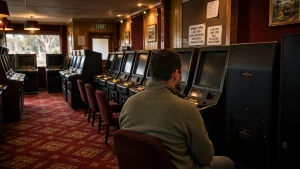
Venue opening times do not necessarily confirm that the gaming area or pokies are operating.
“Open now” is a question about a venue’s current hours, not a guarantee supplied by a search result. If you are deciding whether to visit an Adelaide pokies venue, confirm its opening status directly before setting out. A listing can be useful as a starting point, but it may not reflect a recent change to the venue’s schedule or an unexpected closure.
Check the venue’s own current information first, then contact it if the hours are unclear. A phone call is the most direct way to ask whether the venue is open at the time you plan to arrive and whether pokies are operating. If you cannot get a clear confirmation, do not treat a search-result label as proof. “Open” on a listing may refer to the venue generally; it does not necessarily answer every question about access to its gaming area.
A venue’s doors being open does not, by itself, establish that its pokies are operating. Opening times can apply to different parts of a business, and the information displayed online may not explain those distinctions. Ask specifically about the hours relevant to your visit rather than assuming that all services start and finish together.
This matters if you are looking for early-morning or late-night access. Searches for pokies open early in Adelaide, or for a venue open late, do not establish that a particular place offers those hours. Nor does a time-based listing settle whether machines will be available when you arrive. Confirm the current schedule with the venue, especially when the timing is central to your plan.
Do not infer a daily schedule from a venue’s usual pattern, an old review, or a page that has no clear update information. A result can remain visible after the details it contains have changed. If two sources give different hours, treat that disagreement as a reason to check directly, not as an invitation to choose whichever time is more convenient.
There is also an operating requirement relevant to larger venues. A report published by regionriverina.com.au says that, from 1 July, a venue with more than 20 gaming machines needs a dedicated Responsible gambling officer (RGO) present while those machines are running. That condition concerns staffing during machine operation; it is not evidence that any particular Adelaide venue is open, or that its pokies are running at a given hour.
Keep the distinction clear. A venue may publish its opening hours, but that schedule does not tell you whether machines are operating at the moment you intend to visit. Equally, a staffing requirement tied to machines being in use does not confirm an opening time. Direct confirmation remains the practical way to resolve the hours question.
For a useful answer, ask a specific question: “Are you open now, and are the pokies operating?” If you are planning for a later time, ask whether the venue expects to be open then and whether its gaming area will be available. The wording matters because a general answer about the venue’s doors may not cover the service you are asking about.
Check again if your plans are delayed. Information that was accurate earlier may no longer answer whether the venue is open now. A direct confirmation close to your departure is more relevant than relying on an earlier snapshot, particularly when you are travelling specifically to play pokies rather than visit another part of the venue.
If a venue does not publish clear hours, that is not a reason to fill in the gap from a map result or a third-party listing. Contact it, and make your decision using the answer you receive. If you cannot verify the schedule, plan as though the opening status is uncertain. A few minutes spent checking can prevent a wasted trip; guessing cannot improve the information.
The phrase “pokies open now in Adelaide” may describe what you need to know, but it is not itself a live status check. Search results can point you towards a venue’s contact details. They cannot replace confirmation from the venue about its current hours or machine operation. Keep those as separate questions, and verify both when both matter.
If you’re looking for pokies options in Adelaide in 2026, this list gives you a concise reference to the operators and the details available for each. Use the stated licensing, deposit and payout information to guide what you check before choosing.
SkyCrown
You can note SkyCrown’s stated Tobique Gaming Commission licence and A$30 minimum deposit. Its listed payout times are around 10–15 minutes for crypto and 1–5 days for fiat.
Kingmaker
You can use Kingmaker’s stated A$30 minimum deposit and payout information as reference points: around 90 minutes for crypto and 1–5 days for fiat.
LevelUp Casino
You can note LevelUp Casino’s stated Curacao eGaming licence, OGL/2023/174/0082, held by Dama N.V., and its A$15 minimum deposit.
Neospin
You can note Neospin’s stated Curacao Gaming Control Board licence, OGL/2023/176/0095, held by Hollycorn N.V.
House of Pokies
You can note House of Pokies’ stated international iGaming licence, though the source does not name its jurisdiction. Its listed PayID payouts take 1–24 hours; the minimum deposit is A$30, or A$10 when using PayID.
Uptown Pokies
You can note Uptown Pokies’ stated Curacao licence and that it has been operating since 2017. Its minimum deposit is A$20.
LuckyVibe
You can note LuckyVibe’s stated Curacao Gaming Control Board licence, OGL/2023/176/0095, held by Hollycorn N.V.
Wild Tokyo
You can note Wild Tokyo’s stated Curacao licence and A$10 minimum deposit. Its listed payout times are 30–60 minutes for crypto and 1–5 days for fiat.
7Bit Casino
You can note that 7Bit Casino is stated to be operated by Dama N.V. and licensed in Curacao.
DragonSlots Casino
You can note DragonSlots Casino’s stated Curacao Gaming Authority licence and operator, Jumpman Gaming Ltd.
“Best” is not a useful verdict until you decide what you are comparing. A player looking for a particular theme has a different criterion from someone checking a published return-to-player figure. Neither preference makes a game more likely to pay on the next spin.
For Adelaide pokies, start by separating three things that are often blurred together: the game’s name, its RTP setting, and the outcome of an individual play. A familiar title may be available in more than one RTP configuration. Some game providers let casinos choose between settings, so the same pokie can carry a different theoretical return at different venues. A game name alone cannot settle the comparison.
A specialist review has reported that providers may offer casinos multiple RTP settings for the same game. Treat that as a reason to check the specific setting attached to a particular offering, rather than assuming that every version of a title has an identical return. If a venue or other source makes an RTP claim, look for the exact game version and the stated setting. If those details are absent, the figure may not tell you enough to compare it fairly.
Attention: A game's name alone cannot settle a comparison, as the same title can have different RTP settings at different venues.
RTP describes a theoretical return across play, not a promise about what one person will receive. It does not predict the result of a session, and it cannot tell you when a win will happen. A higher stated RTP can be a relevant comparison criterion, but it is not a reliable way to forecast an individual outcome.
The reason is simple: a pokie’s Random Number Generator determines each spin, and one spin does not depend on the result of the previous one. A run of losses does not make a win due; a recent win does not make the next spin less likely to pay. Patterns that appear meaningful over a short stretch do not change the underlying independence of each result.
That distinction matters when assessing claims about the best-paying pokies in Adelaide. A return figure, if clearly tied to the exact version being discussed, may help compare theoretical settings. It cannot establish which game will pay you more during a visit. “Best paying” can sound like a prediction when the available figure is not one.
A practical comparison should use criteria that can actually be checked. For example:
| Criterion | What it can tell you | What it cannot tell you |
|---|---|---|
| Exact game and version | Whether the claims refer to the same offering | Whether a particular spin will win |
| Stated RTP setting | The theoretical return associated with that setting | Your result in a short session |
| Source of the claim | Whether you can inspect where the figure came from | Whether the figure predicts your outcome |
If two claims refer to different versions or settings, they are not a clean comparison, even when the displayed game title looks identical. If one claim gives no setting or version, mark the comparison as incomplete rather than filling the gap with an assumption. A neat table is useful only when its entries measure the same thing.
This applies whether you are comparing pokies described as being in Adelaide’s CBD, elsewhere in the city, or at a casino venue. A location label does not establish an RTP setting. Nor does a popular title, a striking theme, or a claim that a game is a local favourite tell you its return configuration. Keep the criterion attached to the claim.
If your priority is a particular style of play, compare the features you can verify. If your priority is RTP, compare the stated settings for the same game version and treat unsupported figures cautiously. If your priority is a likely win on your next spin, no title or setting can supply that answer.
That is the limit of a meaningful “best” list: it can organise evidence by a stated criterion, but it cannot rank outcomes in advance. For Adelaide casino pokies, a fair comparison needs a precise basis and a clear boundary between theoretical return and chance. Without both, the ranking is decoration.
If you are arranging a visit around Adelaide Airport, treat proximity as a travel question, not a promise that a venue is inside the terminal or just around the corner. A phrase such as “pokies at the airport” can describe a nearby destination just as easily as a place within the airport itself. Check the venue’s own address before you set out; the wording used to describe a location is not a substitute for its street address.
For a useful comparison, put the practical details side by side: the confirmed destination, the route from where you will start, and whether that route suits your plans. A place that looks close on a map may take a different amount of effort to reach by road than its distance suggests. If you are travelling from the airport, compare the route you would actually use rather than choosing solely by a pin or a short distance label. Geography is not a travel plan.
The same method applies when you are staying in North Adelaide or another nearby area. Start with your own location, then check the route to the venue address. “Near me” depends on where you are when you make the comparison, while “near Adelaide” can cover a much broader area. Neither phrase tells you, by itself, which destination will be simplest for your trip.
If your plans involve the central city, keep that separate from an airport-area comparison. A CBD location may be convenient for one itinerary and inconvenient for another; the deciding factor is the route between your actual starting point and the venue, not the label attached to the area. Decide what matters most to you—less travel, a particular starting point, or fitting a stop into an existing journey—then compare options on that same criterion.
Before leaving, verify the venue’s address through a direct venue contact or its own current information, and check the route with a mapping service. If a listing gives an unclear location, conflicting address details, or no reliable way to identify the entrance, do not treat a nearby map result as confirmation. A map marker can point to a general area rather than the precise place you intend to visit.
This approach is also useful when results appear to place pokies “near Adelaide Airport” or “in Adelaide Airport.” Those descriptions are not interchangeable: one signals a possible nearby destination, while the other suggests a location within the airport. Confirm the actual address and destination before making travel arrangements. If the location cannot be confirmed, choose a plan that does not depend on an assumption about where the venue is.
The best option for your trip is therefore the one that fits your starting point and route—not whichever result sounds closest. Check the destination first, compare the journey second, and avoid building an itinerary around a location label alone.
When comparing Adelaide pokies venues, separate what you can verify about a venue from what would merely sound reassuring. A polished room or a broad claim about looking after patrons does not tell you how gambling-related concerns are documented. One specific point to look for is the venue’s approach to its gambling incident register.
A report by regionriverina.com.au says venues will be required to keep a register recording details of incidents, including occasions when a patron’s behaviour indicates they may be at risk of, or affected by, gambling harm. The register is intended to create a record of such occurrences rather than leave them as informal observations. That gives venue oversight a practical focus: recognising and recording signs of harm.
This is not a ranking measure. A register requirement cannot tell you which venue has the most appealing machines, nor does it establish that one Adelaide venue is “best”. It is a point of comparison about how a venue is expected to document incidents. If responsible handling is part of your decision, the relevant criterion is whether the venue can explain its process for recording and responding to concerns—not whether its advertising uses reassuring language.
You can ask a venue how staff identify an incident, who records it and how the information is handled. Those questions concern the venue’s process; they do not establish that a particular incident has occurred, or that a register is open for public inspection. Avoid treating a confident answer as proof of outcomes. A record-keeping requirement is not, by itself, a promise that gambling harm will be prevented.
For someone comparing pokies venues in Adelaide, this is a narrower but more useful check than a vague claim of “good oversight”. Look for a clear explanation of what kinds of occurrences are recorded, especially behaviour that may indicate a patron is at risk or already affected. If a venue cannot explain the purpose of its register, that leaves you with less information about its approach. It does not, on its own, establish that the venue has breached a requirement.
Keep the criterion in proportion. Incident recording concerns venue-level oversight; it does not show how a particular pokie performs or predict the result of a session. Each spin remains random. A register can help make relevant occurrences part of a documented process, but it is not a scorecard for comparing venues or a guarantee of a safe experience.
The practical comparison is therefore about transparency of process: can the venue describe what the register is for and how incidents indicating gambling harm are recorded? That is a more grounded question than asking which venue is best without defining what “best” means. A clear answer is useful; it is not a substitute for evidence of outcomes.
A search for pokies in Adelaide can point to two different things: machines at a physical venue, or a website offering real-money play. They are not governed in the same way. A local venue search does not make an online casino an Adelaide venue, and a website’s willingness to accept Australian customers does not establish that it can legally provide its games here.
Legal Risk
Under the Interactive Gambling Act 2001, companies cannot offer real-money online pokies in Australia without a domestic licence, and players have no legal recourse in Australia if an offshore casino refuses to pay winnings.
The distinction matters if you are looking for online pokies from Adelaide, including offers described as no-deposit play. Under the Interactive Gambling Act 2001, a company cannot offer real-money online pokies to people in Australia without a domestic licence. No domestic licences for this service have been issued. The rule is directed at the operator providing the gambling service, not at an individual player.
That operator-focused approach can be easy to misread. Australians are not subject to a player penalty under this rule simply for playing on an offshore site that accepts them. But that does not make the operator’s service locally licensed, or give you the protections and remedies you might assume come with a domestic provider. Different questions, different answers.
The practical risk is clearest when a payment or winnings dispute arises. If an offshore casino refuses to pay, Australian players have no legal recourse in Australia to compel it to do so. A site may display polished terms, customer support details or claims about its overseas status; none changes that absence of an Australian remedy. A promised bonus is not a substitute for enforceable recourse.
For a comparison, put the relevant criteria in separate columns: where the play takes place, who provides the service, whether the offer involves real money, and what happens if winnings are withheld. A physical pokies venue and an offshore website do not belong in one undifferentiated list. The first is a land-based venue; the second raises the federal online-gambling rules and a distinct dispute risk. That is a more useful distinction than treating every result for “best pokies Adelaide” as the same kind of option.
Be especially careful not to read acceptance as approval. An offshore site may allow an Australian to register or attempt to play, but access alone does not establish that the operator has permission to offer real-money online pokies in Australia. Nor does the absence of a player penalty amount to endorsement or protection. The operator bears the legal restriction; the player may still face the consequences of dealing with a service that cannot be pursued through Australian legal channels if it withholds winnings.
So, if your priority is a physical outing, keep that separate from online offers. If your interest is real-money play on a website, understand the operator rule and the lack of Australian legal recourse before making a decision. The legal exposure and the financial risk are not the same thing. Neither is trivial.
A phone can make a casino-style game easy to reach; it cannot make the service locally licensed. There is no Australian-licensed online casino. That remains true whether you open a site in a browser, use a mobile app or find it while looking for pokies around Adelaide. The screen changes. The legal position does not.
The distinction matters when a search for Adelaide pokies turns into a request for online play. A nearby result, an Australian-facing page or a payment option familiar to local users is not proof that an online casino holds Australian authorisation. Nor does access from Adelaide establish that a service is lawful to provide here. Convenience is not a licence.
The Australian Communications and Media Authority (ACMA) enforces the Interactive Gambling Act 2001. Under that framework, offering real-money online casino games to people in Australia is prohibited. ACMA can block access to illegal offshore gambling sites, and internet service providers must comply with its blocklist. A page that loads on your device is therefore not evidence of regulatory approval; access and authorisation are different questions.
That is especially relevant when a search for higher stakes or a “best-paying” game appears to lead to an online offer. A headline cannot establish that a game pays more, and a mobile interface cannot establish that the operator is approved in Australia. Treat claims about access, stakes or returns as claims—not as proof of local oversight. The same applies to a site presented as an Adelaide option merely because it mentions the city.
If an account or payment process asks for identity checks, verify what documents are required before any first withdrawal, including proof of identity and address. This is a practical condition to understand before handing over personal information, not a sign that the service is licensed or that winnings are protected. Do not confuse a completed verification step with regulatory approval.
BetStop has a limited scope: it applies to Australian-licensed operators and does not bind offshore sites. It should not be treated as a safeguard for an offshore online casino. If you use it to restrict gambling with Australian-licensed services, that does not extend the restriction to an overseas operator.
For a reader comparing land-based options with online access, keep the categories separate. A venue search concerns places to visit; a mobile casino offer concerns a service delivered over the internet. The word “nearby” describes location, not legal status, and an app does not convert a prohibited online casino service into a locally licensed one. Check what kind of service you are looking at before acting on its claims. The distinction is basic.
A venue’s advertised opening hours and the hours when its pokies are operating are related, but they are not the same thing. If you are trying to establish whether machines are available at a particular time, a staffing rule is relevant context—not a timetable and not confirmation that any Adelaide venue is open.
A report by regionriverina.com.au describes a requirement applying from 1 July: a venue operating more than 20 gaming machines must have a dedicated responsible gambling officer (RGO) on duty during machine operation. The condition is tied to the machines being run. It does not, by itself, set a venue’s opening or closing time, nor does it establish that a venue operates around the clock.
That distinction matters when interpreting claims about late-night or continuous availability. A venue could have opening hours that do not match the period its machines are operating; the staffing condition addresses the latter, not the former. It would be a mistake to use the RGO requirement as evidence that pokies are running at a specific hour.
The threshold also matters. The report concerns venues with more than 20 machines, so the condition should not be casually extended to every venue. Nor does a general description of the rule establish how many machines a particular Adelaide location has or whether it has an RGO on duty at a given moment. Those are venue-specific details.
Staffing Requirement
From 1 July, any venue with more than 20 gaming machines must have a dedicated Responsible gambling officer (RGO) present while those machines are running.
For a practical comparison, separate three questions: when the venue admits patrons, when its pokies are operating, and whether the staffing condition applies during that operation. The first two concern the venue’s own schedule. The third concerns the described requirement for larger machine operations. Treating them as one question produces a confident answer to the wrong one.
If a listing describes a venue as open late, that wording does not prove its pokies are running throughout those hours. Likewise, knowing that a staffing condition applies when machines operate does not tell you when they start or stop. The distinction is plain, even if listings blur it.
For anyone checking Adelaide pokies hours, the useful takeaway is narrow: machine operation at a venue above the stated threshold carries a specific RGO staffing condition, according to the report. It is not a promise of continuous access, a guide to local schedules, or a substitute for confirming the venue’s current operating information directly.
Hours are one criterion; machine availability is another. Keep them in separate columns. A tidy table beats a guess.
A reference to Crown alongside Adelaide does not establish that a Crown casino or Crown pokies venue is located in the city. The wording may bring those terms together, but it is not evidence of a venue’s presence, its machines, or what a visitor would find there. Keep the distinction clear: a name in a search phrase is not a verified local listing.
The comparison point that can be stated is narrower. A specialist review reports that some game providers let casinos choose between different return-to-player (RTP) settings for the same pokie. As a result, the game title alone does not establish its RTP at a particular casino. The same title may be configured with a different return percentage at another venue.
That limitation matters if you are trying to judge a Crown-related claim against an Adelaide venue. A general statement about a game’s RTP cannot, by itself, confirm the setting used at a named casino. Nor does the fact that a game appears in a comparison establish that its configuration is identical across locations. The specific setting needs to be stated for the particular casino and game before an RTP comparison can be made.
A useful comparison therefore needs a defined criterion and a clear basis. If the criterion is RTP, compare the stated setting for the same game at the venues under consideration. If a claim gives only a game name, it leaves the relevant setting unresolved. If it names Crown but does not identify a specific casino configuration, it still does not establish an Adelaide-specific comparison.
The same restraint applies to claims about the “best” pokies room or a maximum cash payout. The RTP information described here does not identify a room, rank venues, or establish a payout ceiling. Those are separate claims and cannot be derived from a game’s return setting. A percentage attached to a pokie is not a promise about the result of an individual play, and it does not supply a maximum cash-out figure.
For your own comparison, separate three questions: which venue is being discussed, which exact game is meant, and which RTP setting is stated for that game at that venue. If any part is unclear, the comparison remains incomplete. That is not a verdict for or against Crown, or for any Adelaide venue. It is simply the limit of what the RTP caveat can support. A name is not a setting.
A venue’s address or club status does not tell you what its oversight record contains. The relevant measure here is a gambling incident register: a record intended to capture occurrences at the venue, including situations where a patron’s behaviour indicates they may be at risk of, or affected by, gambling harm.
A report by regionriverina.com.au describes this register requirement. Its purpose is to document incidents, not to rank venues or identify which one has the “best” pokies. That distinction matters if you are comparing Adelaide CBD venues or clubs: a register requirement describes an oversight process, but it is not evidence about the conduct, machine selection or safety record of any particular place.
The register’s stated scope is broader than a single kind of event. It includes occurrences involving behaviour that signals possible gambling harm. That makes the record relevant to how a venue responds to concerns, rather than a guide to games or a measure of likely returns. A name on a map cannot answer those questions.
It also does not mean that a visitor can inspect a venue’s register, or that public venue-by-venue records are available. Do not treat the requirement as a published scorecard. Without specific information about an individual venue, the register rule cannot support a claim that one CBD location or club is better overseen than another.
If self-exclusion is part of your decision, keep it separate from the register question. Self-exclusion is a responsible-gambling tool; the incident register concerns occurrences recorded by venues, including behaviour that may indicate gambling harm. They address related concerns, but they are not interchangeable. A register is not a substitute for a personal exclusion choice.
For a practical comparison, ask what you actually need to establish. The existence of a register requirement tells you that certain incidents are meant to be recorded. It does not tell you how often incidents occur at a specific venue, what response followed, or whether one venue is preferable. Those are separate venue-level questions, and no invented CBD or club ranking can answer them.
The criterion is clear: the register provides an oversight record of relevant occurrences, not a recommendation. Keep that boundary in view when assessing claims about Adelaide pokies venues. A record is not a rating.
PayID is not a separate wallet or a measure of how a venue handles cashless play. It is an alias service connected to Australia’s New Payments Platform (NPP): a transfer can be addressed using an email address, mobile number or Australian Business Number rather than bank-account details. Whether that payment route is available depends on the bank and the recipient.
A specialist review reports that some Australian banks, including members of the Big Four, have at times blocked PayID transfers identified as going to gambling merchants. That is a reported restriction, not a guarantee that every bank will block a payment or that a transfer will succeed if it does not. Check your bank’s current rules before relying on PayID, and do not treat a failed transfer as proof of a problem with a particular Adelaide venue.
The distinction matters when you are comparing cashless options around Adelaide, or weighing up travel plans that include Newcastle. A payment method does not tell you whether a local pokie venue accepts cashless payments; confirm payment arrangements with the venue directly. Nor does PayID support show that an online gambling service is licensed, that its games are fair, or that it publishes accurate RTP information.
PayID describes how funds are addressed and transferred. It does not verify what happens after the money reaches a recipient. If you are assessing a service, keep payment convenience separate from questions about its legal status, game information and withdrawal terms. Those are different checks.
A familiar bank-transfer method can make a payment feel ordinary. It does not make the destination trustworthy. For an Adelaide visit, the practical question is simply whether the venue accepts the payment method you intend to use; for an online service, PayID alone answers none of the harder questions.