The phrase does not identify a particular property, licence or service, so its meaning depends on whether it refers to an on-site venue or a website.
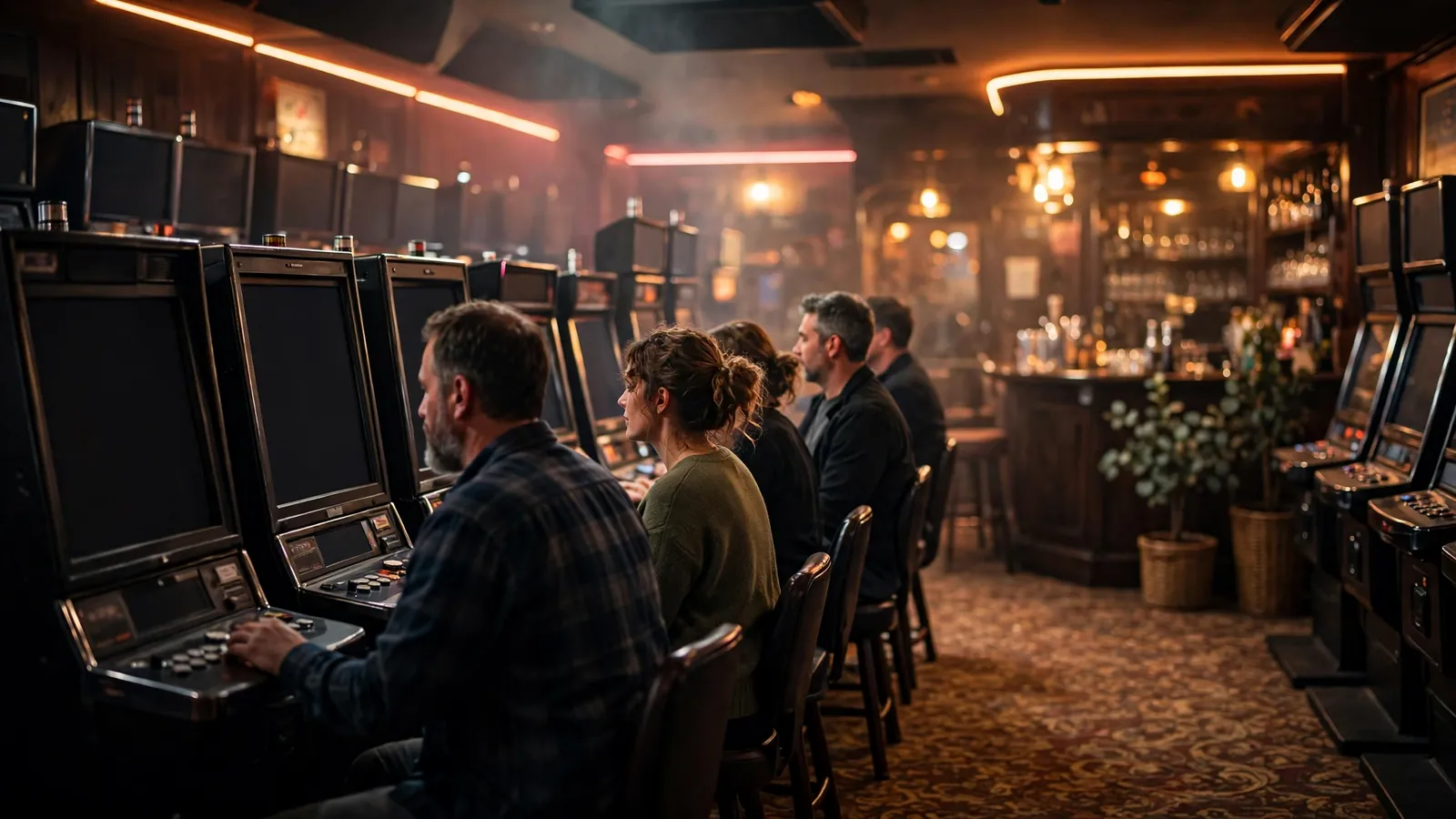
“Pokies parlour” is an informal label, not a single Australian casino category with one standard meaning. It may point to a physical casino environment where electronic gaming machines are part of the offering, or simply be wording someone uses when looking for a casino experience. “Pokie parlour” and “parlour casino” are variations on the same idea; the wording alone does not identify a particular property, licence or type of service.
The useful distinction is between a place you can physically enter and an online gambling service. A parlour, in this context, suggests an on-site setting. A website offering casino-style gambling is a different kind of service, even if its branding uses words such as “casino” or “parlour”. Similar language does not make the two settings interchangeable.
That matters because the label can sound more precise than it is. It does not tell you whether a result refers to a full-scale casino, another kind of gaming venue, or a business using the phrase as promotional wording. Nor does it tell you what facilities are available at a property. Treat “parlour” as a clue to the intended setting, not as proof of a formal classification.
If you’re looking for a pokies-style casino option in Australia, this list gives you a concise reference to the details available for each operator. Use the stated licensing, deposit and payout information to help decide what to check before signing up.
SkyCrown
SkyCrown lists a Tobique Gaming Commission licence and a minimum deposit of A$30. Its stated payout times are around 10–15 minutes for crypto and 1–5 days for fiat.
Kingmaker
Kingmaker lists a minimum deposit of A$30. Its stated payouts take around 90 minutes for crypto and 1–5 days for fiat.
LevelUp Casino
LevelUp Casino lists a Curacao eGaming licence, OGL/2023/174/0082, held by Dama N.V., and a minimum deposit of A$15.
Neospin
Neospin lists a Curacao Gaming Control Board licence, OGL/2023/176/0095, held by Hollycorn N.V.
House of Pokies
House of Pokies lists an international iGaming licence, though the jurisdiction is not named in the available information. Its stated PayID payout time is 1–24 hours; the minimum deposit is A$30, or A$10 for PayID.
Uptown Pokies
Uptown Pokies lists a Curacao licence and says it has operated since 2017. Its minimum deposit is A$20.
LuckyVibe
LuckyVibe lists a Curacao Gaming Control Board licence, OGL/2023/176/0095, held by Hollycorn N.V.
Wild Tokyo
Wild Tokyo lists a Curacao licence and a minimum deposit of A$10. Its stated payout times are 30–60 minutes for crypto and 1–5 days for fiat.
7Bit Casino
7Bit Casino lists a Curacao licence and is operated by Dama N.V.
DragonSlots Casino
DragonSlots Casino lists a Curacao Gaming Authority licence, with Jumpman Gaming Ltd as the operator.
In ordinary Australian usage, “pokies” refers to electronic gaming machines. Adding “parlour” gives the phrase a physical, room-like feel, but it does not establish that the place is a separately defined parlour or that every casino has a distinct area carrying that name. A casino may be described informally in several ways by visitors and businesses. Those descriptions are not substitutes for the property’s official details.
A practical reading is therefore simple: the phrase points towards an interest in an in-person casino setting, but the venue itself needs to be understood on its own terms. If you are comparing options, separate the label from the attributes that matter to you. The relevant criterion might be whether the property is a licensed casino, where it is, or whether its published information matches the visit you have in mind. There is no single “best” parlour by wording alone; the right fit depends on what you want from a physical venue.
A name can be suggestive. It is not a licence.
Australia does not have one national casino licence covering every property. Casino regulation sits with the states and territories, and each casino operates under a licence issued by the jurisdiction where that property is located. So the regulatory context is local to the venue, even though the general phrase “Australian casino” sounds national.
 Casino Guides for Australian Players: Deposits and AppsExplore guides to Australian casino deposit options, mobile apps, withdrawals, licensing and account features, with topics grouped for easier comparison.
 Casino Apps in Australia: Legal and Mobile AccessLearn how offshore casino apps differ from local services, and what to check for bonuses, deposits and withdrawals. Australian law bars operators…
For you, this means that a casino’s status is tied to its actual property and the local authority responsible for it—not to a broad label applied in an advertisement, directory entry or conversation. The words “pokies parlour casino” do not create a separate legal category, and they do not establish that a business is authorised to operate as a casino. The useful comparison is between the physical property and its jurisdictional licensing context, rather than between competing versions of the phrase.
This local framework also explains why a single description may not answer every practical question. The phrase does not specify the venue’s rules, available facilities or conditions of entry. Those are matters for the individual property and the relevant jurisdiction. When information is unclear, relying on the label alone is a poor way to settle it.
The minimum age for casino entry is 18 across Australia. That is a nationwide entry threshold, not a promise that every other condition will be identical at every property. A person considering a visit should distinguish the general age rule from venue-specific entry arrangements.
The distinction between a physical venue and an online service remains important here too. A phrase that sounds like a room or parlour should not be read as evidence that an online version has the same status as an Australian casino. A real property has a location and a licence issued by its local jurisdiction; a website is not made into that property by borrowing its vocabulary.
When you see the phrase, read it as a rough description of the intended subject: an in-person casino or gaming-room experience involving pokies. Then check what the particular business actually is, where it operates, and whether the description refers to a physical venue. That gives you a firmer basis for understanding the term than treating “parlour” as an official badge.
Treat the term "parlour" as a clue to the intended setting, not as proof of a formal classification or a licensed status.
A sign-up bonus or no-deposit offer can sound like a small promotional detail: an invitation to register, then receive a benefit without making an initial payment. In Australia, that wording does not change the legal character of the service behind it. The relevant test is not whether the promotion asks for a deposit, but whether an operator is offering a prohibited interactive gambling service to people in Australia or advertising such a service to them.
The Interactive Gambling Act 2001 bars operators from providing real-money online casino gambling to customers physically located in Australia. A registration reward does not create an exception. Nor does describing an offer as free, introductory or limited to new accounts make a prohibited service lawful. The promotion and the gambling service need to be considered together.
That distinction matters when you see phrases such as “no-deposit bonus” or “sign-up offer” attached to an online casino. They describe a marketing claim, not evidence that the offer can lawfully be made to Australians. The same applies if the wording is presented as a reward for opening an account rather than as an inducement to gamble. The label may change; the underlying regulatory question does not.
The Australian Communications and Media Authority, or ACMA, is the federal regulator responsible for enforcing the Interactive Gambling Act and monitoring compliance with national interactive-gambling laws. It can investigate prohibited services and take enforcement action. Where a website provides an illegal interactive gambling service or advertises one in Australia, ACMA may ask Australian internet service providers to block access to it.
 Pokies Open Near Me in Australia: Casino HoursLearn what “open now” means, how venue hours differ from individual facilities, and why a 24-hour casino may not offer every service…
 iPad Casinos in Australia: Legal Access ExplainedLearn how iPad compatibility differs from legal access to real-money casino games in Australia, where the Interactive Gambling Act 2001 makes their…
This is an enforcement mechanism, not a guarantee that every prohibited service will disappear as soon as it is identified. ACMA reports that, following enforcement actions since November 2019, it has blocked more than 1,455 illegal gambling and affiliate websites. That figure covers both gambling services and affiliate sites, so it should not be read as a count of casino operators alone.
There is also a reported withdrawal figure, but published accounts do not agree on the total. One version says more than 210 illegal services have left the Australian market since ACMA began enforcing the rules in 2017; another gives the figure as over 190. Either way, withdrawals and blocking actions are evidence of active enforcement, not proof that a particular offer has been assessed or approved.
A useful way to assess a sign-up claim is to separate three things that promotional wording often bundles together:
| What the wording says | What it establishes |
|---|---|
| You can register without depositing | Only that the promotion is described as requiring no initial payment |
| A reward is available to new customers | Only that the operator is making a promotional claim |
| The offer is presented to Australian users | A reason to consider the federal advertising rules, not proof of approval |
Promotional language can make an offer sound like a harmless account feature, but it cannot override the law. Advertising real-money online casino services to an Australian audience is prohibited, and operators may face enforcement for providing or advertising prohibited services. The maximum daily penalties set out under the Act are $360,000 for an individual and $1.8 million for a body corporate. These are statutory maximums, not a prediction of what will happen in any particular case.
For you, the practical distinction is between understanding what a promotion claims and treating it as an invitation to participate. A “no deposit” description does not establish that an Australian customer may lawfully use the service, and a sign-up bonus is not a regulatory endorsement. If the offer promotes online casino gambling to Australians, the central issue is the lawfulness of the service and its advertising—not how appealing the reward sounds.
A headline is not a licence.
Federal Prohibition
The Interactive Gambling Act 2001 bars operators from providing real-money online casino gambling to customers physically located in Australia.
A page that opens on your phone can look like a usable service. It may show menus, invite you to create an account or accept account traffic. None of those signs establishes that the site is an Australian-licensed online casino. Technical access is evidence only that a page can be reached in that moment; it says nothing by itself about whether the service may lawfully provide gambling to people in Australia.
That distinction matters because the rules for a physical casino and an online casino are not interchangeable. Australian casinos operate under licences issued by their state or territory. That local licensing framework does not create a corresponding permission for an online casino to offer real-money games to people in Australia. The Interactive Gambling Act 2001 prohibits operators from providing real-money online casino games to customers physically located here.
So an online page using Australian language, currency references or familiar casino wording is not proof of local authorisation. Nor is a successful registration, a confirmation message or an account dashboard. These features may make a service appear complete, but appearance and lawful status are separate questions. A website can function as a website without being entitled to provide the gambling service it describes.
 Online Pokies E-Wallets in Australia: Mobile UseLearn how browser access differs from e-wallet payments, and why a method listed for deposits may not be available for withdrawals. MiFinity,…
 Instant Withdrawal Casinos in Australia: Payment RulesLearn how mobile browser access, PayID deposits and crypto withdrawals work, and why KYC checks or bonus terms can delay access to…
A free-play label can also leave the important point unresolved. It may describe a demonstration, a promotional message or a feature inside a broader service. The label alone does not show what happens after registration, whether the activity involves real money or whether an operator is permitted to offer the service in Australia. It is not a regulatory credential.
If you are comparing an online page with a physical casino, keep the categories separate. A licensed venue is governed by the rules of its jurisdiction; an online service is subject to the federal prohibition on real-money casino games for customers in Australia. A familiar venue name, logo or style on a screen does not transfer a physical licence to an internet service. The screen is not the licence.
This is why “it loads” is a poor test. It measures connectivity, not compliance. “It accepted my details” is no stronger: an account process is a feature controlled by the site, not a decision by an Australian regulator. Even a polished site can leave the central legal question unanswered. Good design is not a regulatory category.
The same caution applies when a page describes itself as available to Australians or presents an Australian-facing sign-up path. A claim made by the service is not independent evidence of permission. Under the Interactive Gambling Act, responsibility for providing prohibited services rests with operators; the legal position should not be inferred from a site’s marketing language or its ability to process account activity.
A sound comparison therefore starts with the kind of service, not how smoothly its pages behave. If the activity is real-money online casino gambling offered to customers in Australia, the relevant rule is prohibition—not a choice among locally licensed online casinos. If the page is only a free demonstration, that does not convert it into proof of authorisation for real-money play. Those are different claims, and one does not establish the other.
For a reader looking for an online version of a pokies parlour, the practical takeaway is narrow but important: access is not approval. A site may be visible, interactive and responsive while still failing to demonstrate lawful authority to offer online casino gambling here. Keep the inference modest. A working page proves a working page.
“Free chips” and “free spins” sound straightforward, but the label alone tells you little about what is being offered. It does not establish that the benefit is genuinely cost-free, available to you, or lawful for an Australian audience. Treat the wording as a claim to assess, not an invitation to sign up.
Start with the exact terms attached to the promotion. Look for who may qualify, what action is required, whether a deposit or purchase is involved, and whether the benefit can be used only in particular circumstances. “Free” may describe the promotional credit rather than the whole process: an offer could still involve account requirements or other conditions. If the conditions are hard to find, unclear, or inconsistent with the headline, the headline is not enough to make a sound decision.
 Highest-Payout Online Casinos in Australia ExplainedLearn what slot RTP can and cannot show, how it differs from session results, and why payout rates are not the same…
 $1 Minimum Deposit Pokies in Australia: What It MeansLearn why a casino’s stated minimum may differ from the amount a payment route accepts. One review places a usable Australian deposit…
The same applies to claims about free spins. The phrase does not tell you how the spins are issued, what restrictions apply, or whether any resulting balance can be withdrawn. Those details matter more than the attractive shorthand. Read the complete terms before sharing personal information or making a payment, and do not infer that a benefit has cash value simply because it is displayed beside a dollar sign or a balance figure.
A free-chip promotion can also be framed to sound like a harmless trial. That wording does not settle what happens next. Check whether the offer is tied to a paid service, whether continued participation requires further steps, and whether the terms explain how the promotion ends. If key details are missing, avoid filling the gaps with assumptions. The promise may be brief; the conditions may not be.
Most importantly, promotional wording does not prove that an online casino service may lawfully be supplied in Australia. The Australian Communications and Media Authority (ACMA) monitors compliance with federal interactive-gambling laws, including the Interactive Gambling Act 2001. That is relevant context, not an endorsement of a particular promotion. A polished banner, a familiar phrase, or a page that presents itself as local cannot turn the wording into evidence of lawful availability.
Keep the assessment practical: identify the promoter, read the full terms, note any required action, and check whether the claim is consistent across the advertisement and its conditions. If the promoter is unclear or the terms cannot be located, you have no reliable basis for treating “free” as a useful description. No need to solve a riddle.
For a physical casino setting, promotional language may refer to a different arrangement from an online offer. Do not assume that a phrase used on a website describes a benefit available at a venue, or vice versa. Ask what the promotion actually applies to and where its terms say it applies. The distinction is simple; the wording often is not.
The Australian Communications and Media Authority (ACMA) monitors compliance with federal interactive-gambling laws, including the Interactive Gambling Act 2001.
A review can describe a website, but its address is not a credential. If a page refers to a “new” or “official” domain, treat that as a claim to assess, not evidence that the service is legitimate. The useful question is not whether the address looks familiar; it is whether the review gives clear, checkable reasons for presenting it as trustworthy.
Domain changes have a practical explanation: website blocking can affect which addresses resolve through Australian internet service providers, and alternate addresses may appear over time. The Australian Communications and Media Authority (ACMA) has taken blocking action against illegal gambling services, including alternate domains associated with Fair Go. That enforcement record helps explain why an address may stop working or why another one is promoted. It does not make a replacement address an endorsement.
Read the review’s reasoning before following any link. A credible assessment should make clear what it checked and when, and distinguish those observations from claims supplied by the operator or a third party. “The address changed” is a description. “The new address is safe” is a conclusion—and it needs evidence beyond the fact that the page opens.
Watch for circular support: a review calls a domain official because the site says so, then cites the site’s own statement as confirmation. A list of alternate addresses, without an explanation of their status or a reliable basis for the claim, is not verification. Nor does confident wording turn an assertion into a finding. A polished review can still have a weak evidence trail.
The same standard applies to older reviews. A page may have been accurate about an address when published and become stale after a change. Check whether its date is visible, whether it acknowledges that links can stop resolving, and whether its claims are tied to a specific address rather than loosely carried forward. If the review does not say when it checked, you cannot tell whether its details are current.
When comparing pokies parlour reviews, use the same criteria for each:
These criteria help you compare the quality of the review, not the apparent convenience of its links. If two reviews disagree, note what evidence each provides and whether either addresses the domain change directly. Do not treat repetition across several pages as independent confirmation if they appear to rely on the same claim.
A concise review with a transparent basis may be more useful than a longer page full of confident assurances. Conversely, a missing date or unexplained redirect does not, by itself, prove wrongdoing; it tells you that the review has not established what you need to know. Keep that distinction intact. An alternate domain is an address, not a verdict.
Australia’s casino footprint is spread across the country rather than concentrated in a single state or city. A specialist gambling-market review counts more than 20 full-scale casinos across all eight states. Treat that as a snapshot from a secondary source, not a permanent official total: facilities can open, close or change status, and the count depends on what the reviewer includes as a full-scale casino.
The same review identifies gambling facilities in 147 Australian cities. That is a much broader measure than casino locations alone. It captures a geographic spread of gambling activity, not a count of cities with a full-scale casino in each one. The distinction matters: a map showing many gambling cities does not mean that each offers the same range or scale of facilities.
Sydney stands out in that review’s city comparison. It is listed as Australia’s largest gambling city, with 11 gambling facilities. That figure describes the review’s facility count; it should not be read as a count of casinos alone or as a live directory. For a reader comparing locations, the useful point is the concentration: Sydney is presented as a major centre, while the national picture extends well beyond the largest city.
These figures answer different questions:
| Measure | What it indicates |
|---|---|
| More than 20 full-scale casinos | The scale of the casino sector in the review’s count |
| 147 gambling cities | The breadth of gambling activity across urban locations |
| 11 Sydney facilities | The number attributed to Australia’s largest gambling city in that review |
The table is a comparison, not a ranking of places to visit. “Gambling facility” is broader than “casino”, so the 147-city figure and the full-scale casino count should not be combined or treated as interchangeable. Nor does Sydney’s facility count establish that it has the greatest number of full-scale casinos; the source describes it as the largest gambling city.
The national spread also makes a single city-centred picture incomplete. Someone comparing Australian locations should separate the size of the overall casino sector from the number of cities where gambling facilities are recorded, then consider how a particular location fits the purpose of the comparison. A city count can show reach; it cannot, by itself, tell you what each venue offers, how it is operated, or whether its details remain current.
The figures are still useful as orientation, provided their source and scope stay attached. The specialist review supplies a stated count, not a guarantee that every listing is current or defined in the same way by other directories. That is a modest but important distinction. Counts travel farther than their definitions.
For a broad view, the comparison points to a nationwide casino sector and gambling activity reported across many cities, with Sydney prominent in the cited city-level tally. For a precise local picture, check the specific location and facility rather than inferring its details from a national number. The map gives scale; it does not give every address.
A bonus label attached to a casino or pokies parlour tells you that someone is describing an incentive. It does not establish that the offer exists, that it is available to you, or that it is lawful in Australia. The wording may be broad enough to cover very different things, so the label alone is a poor basis for deciding what an offer means.
The relevant distinction is not whether the promotion sounds generous. It is what service it relates to and where that service is offered. The Interactive Gambling Act 2001 prohibits operators from providing real-money online casino games to people in Australia, and advertising those services is also prohibited. A promotional claim does not change that legal position. ACMA, the Australian Communications and Media Authority, is the federal body responsible for enforcing the Act and monitoring compliance with interactive gambling laws.
That makes a generic casino bonus claim different from evidence of a lawful offer. A headline, banner or promotional description cannot demonstrate that an online casino service is permitted for Australian customers. Nor does polished wording make an otherwise prohibited service acceptable. A label is not a regulatory finding.
Even outside the question of legality, the word “bonus” is incomplete. It does not tell you what the incentive applies to, who is eligible, whether conditions attach, or whether the description matches the actual terms. Those details matter because a promotional label can leave out the very information needed to assess it.
A useful comparison starts with the category of claim, not its headline. Is it describing an online casino service, a land-based venue, or something else? Is the full wording available, and does it explain the relevant conditions clearly? If the answer is missing or unclear, there is not enough information to treat the headline as proof of an offer. No headline can do that work.
The standard should be especially firm when the claim invites you to register or deposit with an online casino. Do not treat a bonus description as evidence that the underlying service is lawful for people in Australia. The legal test concerns the service and its provision, not the appeal of the incentive.
So a casino bonus label can identify the kind of claim being made, but it cannot verify its terms or legality. Compare the claim against the service it refers to and the applicable rules; if those do not line up, the promotional wording settles nothing.
“VIP” can describe a status, room or service in a venue’s own language, but the label alone does not tell you what access involves. It is not a guarantee of admission, special treatment or particular benefits. Check the venue’s published entry conditions and distinguish a general casino visit from access that may have separate requirements.
For practical planning, the clearest baseline is opening time: all major Australian casinos operate around the clock. That does not mean every facility, service or area is available at every hour. If your plans depend on a particular space or amenity, confirm its arrangements directly with the venue rather than treating the casino’s overall opening hours as a promise about every part of the property.
Entry has a nationwide age threshold of 18. Major casinos also require valid photo identification, so bring acceptable ID even if you have visited before or expect to enter with a guest. A VIP designation does not replace age or identity checks. Access conditions still apply.
The useful comparison is therefore not “VIP versus ordinary” as a vague status contest. It is whether the access you need is confirmed, whether you meet the stated entry conditions, and whether the relevant area will be available when you arrive. If those details are not clear, the label has little practical value. Plainly put: check the conditions, not the gloss.
A casino may be open all day while a particular experience is limited by its own access rules. Treat a VIP parlour description as a claim to verify with the venue, not as evidence that entry is automatic or that a benefit is included. The sensible choice depends on your purpose: straightforward entry, a specific area, or a service with stated conditions. Check that criterion before making plans.
“Parlour pokies” can refer informally to the gaming machines associated with a casino setting. The phrase does not, by itself, identify a particular venue, machine type or standard layout. If you are comparing what the term suggests with what a casino actually provides, the useful measure is the licensed machine count—not the label.
Across Australia, 3,308 gaming machines are endorsed on venue licences and installed in casinos. That is a national total, not a count for each casino or a promise that a particular parlour contains a particular number. The equipment available varies by venue, so the word “parlour” should not be read as a guarantee of identical facilities from one location to another.
The figure also has a defined scope: it concerns machines licensed for and installed in casinos. It is not a count of every gaming machine in Australia, nor does it describe machines in other kinds of venues. Keeping that distinction clear prevents a broad national statistic from being mistaken for a venue-level inventory.
If the practical question is what a specific casino has on site, a national total cannot answer it. You would need current information for that venue, and the licence context matters: the machines included in the count are those associated with casino licences. The term alone tells you little about the number or arrangement of machines in any one parlour.
A simple comparison table helps keep the claims separate:
| Claim | What it tells you |
|---|---|
| Parlour pokies | Informal wording for casino gaming machines |
| 3,308 machines nationally | The combined count endorsed on casino venue licences and installed in casinos |
| A particular parlour’s facilities | Not established by the national figure |
The count is specific; the label is not.
The words “real money” change the question. They distinguish gambling for cash from a demonstration mode, but they do not establish that an online casino may lawfully serve people in Australia. A page can describe deposits, play and withdrawals in confident terms while offering no evidence that its service is permitted here.
Under the Interactive Gambling Act 2001, operators cannot provide real-money online casino games to people physically located in Australia. That prohibition covers casino-style services such as slots, poker, blackjack and roulette. The relevant distinction is not whether a site calls itself a parlour, casino or gaming platform; it is the nature of the service being offered to customers in Australia.
A working website is not a regulatory credential. Nor is the ability to create an account, receive messages or reach a page through a different address. Those signs establish access, not Australian authorisation. Treating them as proof would confuse a technical result with a legal one.
For a reader comparing claims, separate three things: what the site says it offers, whether the service involves real-money casino gambling, and what Australian law permits. Promotional language may blur those categories; a clear comparison keeps them apart. A polished page, familiar terminology or a functioning account flow does not change the legal framework.
This is an informational distinction, not an invitation to test a service or make a deposit. If a page presents real-money casino play as available to Australians, its wording should be read against the federal prohibition rather than taken as assurance of lawful access. The decisive criterion is the service’s status under Australian law—not whether the page loads.
That is the useful dividing line.